
Indigenizing Media: What Canada’s Indigenous Publishing Looks Like in 2026
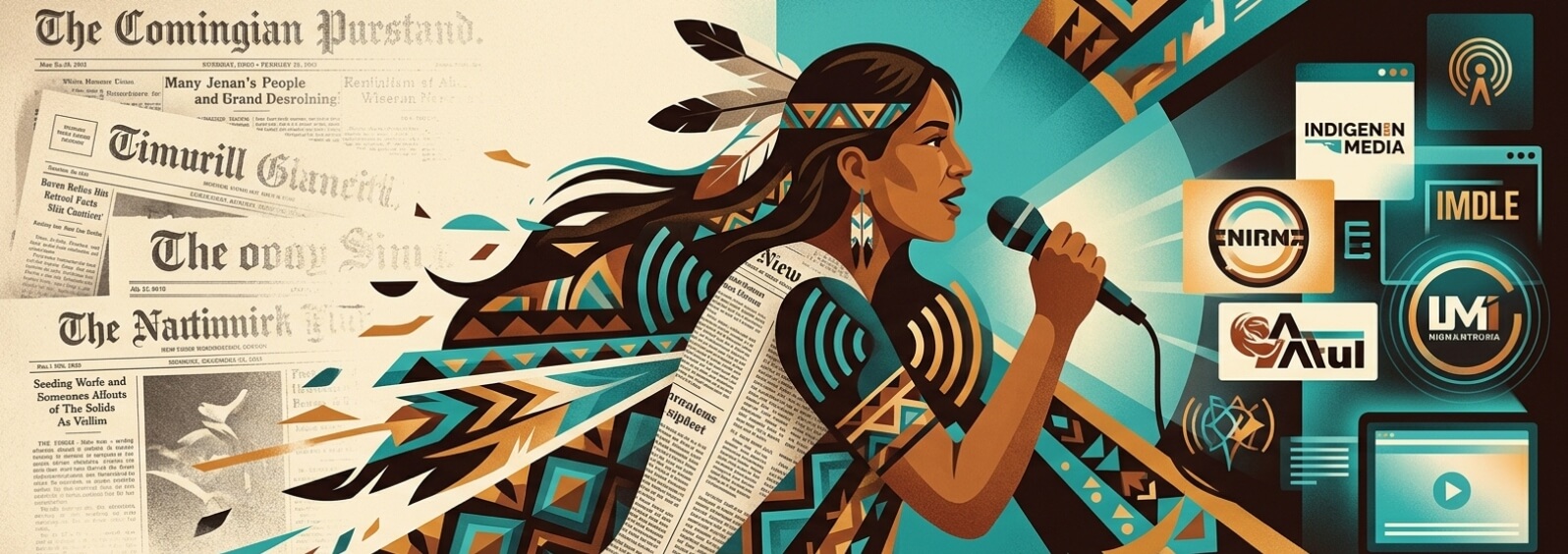
Indigenizing media means Indigenous communities owning the platform, setting the editorial agenda, and deciding who the story is for, not being represented in someone else’s publication on someone else’s terms. Here is why that distinction matters, and what it looks like in practice.
What ‘Indigenizing Media’ Means
The phrase indigenizing media gets used a lot, often loosely. In practice, it refers to something specific: restructuring media production so that Indigenous perspectives are not just represented, but central – to ownership, editorial decision-making, and accountability.
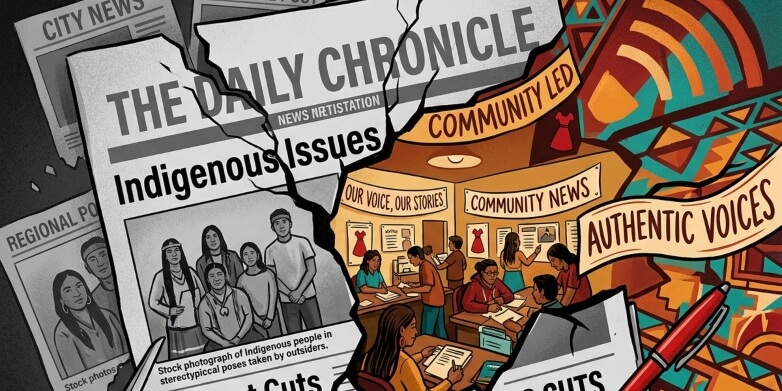
It is not the same as diversity programming. A mainstream publication can hire Indigenous writers while still making every structural decision through a non-Indigenous editorial lens. Genuinely indigenized media starts from a different premise: the community is the audience, the authority, and the owner of the story.
In 2021, Canada adopted the UN Declaration on the Rights of Indigenous Peoples (UNDRIP) into law through Bill C-15. Article 16 of UNDRIP explicitly affirms the right of Indigenous peoples to establish media in their own languages. That legal recognition matters, but independent publishers were already building long before the legislation caught up.
The Gap That Made It Necessary
Ask anyone who has worked in Indigenous community media why independent platforms exist, and you will hear variations of the same answer: mainstream outlets were not getting it right, and communities got tired of waiting for them to try harder.
The failure was not just representational, it was structural. The human rights act frameworks governing Canadian broadcasting were designed without meaningful Indigenous input. CRTC licensing requirements for Indigenous broadcasters help, but they do not cover independent print or digital publishing. If communities want guaranteed access to their own public sphere, they have to build it.
The years of the Harper government accelerated this. Federal cuts to Indigenous organizations, the delayed national inquiry into Missing and Murdered Indigenous Women and Girls (MMIWG), and the framing of the residential school apology as a closed chapter rather than an ongoing reckoning all reduced the institutional channels through which Indigenous voices could reach the public. Independent media filled that vacuum.
Note
The Truth and Reconciliation Commission’s Calls to Action 84-86 specifically address Indigenous media: they call on the CBC and other outlets to establish Indigenous advisory committees and expand support for Indigenous journalism. Independent publishers were already doing this work without waiting for institutional buy-in.
Art, Music, and the Case for Indigenous Magazines
Canada has plenty of art magazines, music magazines, and cultural publications. What it has historically lacked is publications that centre Indigenous aesthetics, Indigenous criticism, and Indigenous readers as the primary audience, not as a niche subset of a broader readership.
The difference is not cosmetic. A spirit magazine rooted in Indigenous cosmology engages with ceremony, land relationships, and intergenerational healing in ways that have no direct equivalent in mainstream wellness publishing. A body magazine written by and for Indigenous women carries histories of violence, survival, and sovereignty that most general-interest titles simply do not touch.
Music magazines in Canada that take Indigenous sound seriously, not as folk curiosity or roots music, but as a living political and artistic force, are rare enough that their absence is its own statement. Drum-based traditions, throat singing, Cree-language hip-hop, and contemporary Indigenous electronic music all exist within active communities. For the most part, they exist without consistent mainstream critical coverage.
Mainstream Arts Media | Independent Indigenous Media |
|---|---|
Reviews work through Western critical frameworks | Evaluates work on the community’s own terms |
Indigenous art treated as niche or ‘world music’ | Indigenous art as central, not exotic |
Publishing calendar driven by market trends | Calendar driven by community events and seasons |
Advertiser relationships shape editorial tone | Community accountability shapes editorial tone |
National distribution infrastructure | Grassroots and community-based distribution |
Land, Language, and Decolonial Love
The most interesting work coming out of independent Indigenous publications tends to orbit three things: land, language, and what scholars have called decolonial love – the practice of caring for relationships, territories, and cultural inheritance as acts of political and personal resistance.
Land, in this context, is not a metaphor. An Anishinaabe Ikwe writing about navigating an urban village, the informal networks of Indigenous community in a city like Winnipeg, is writing about dispossession, migration, and new community infrastructure in the same sentence. Perspectives on how the land and our bodies are connected run through Indigenous writing in a way that has almost no equivalent in mainstream Canadian publishing.
Language revitalization is inseparable from this. Publishing partly in Ojibwe or Michif is not a token gesture toward heritage, it is a statement that the publication’s first audience is the community itself. As the drum beats through ceremonies, round dances, and community gatherings, independent media follows that rhythm rather than imposing an external editorial calendar.
Two-Spirit Voices and Body Sovereignty
Mainstream Canadian media has done a poor job covering Two-Spirit identity. That is, if we are being honest, barely covered it at all except as an explanatory aside in broader LGBTQ+ stories. Independent Indigenous publications are where Two-Spirit writers can actually speak for themselves.
Body sovereignty and gender self-determination are not abstract concepts in this space. They reflect the lived reality of Indigenous people navigating colonial healthcare systems, legal definitions of gender that erase their identities, and social environments still shaped by residential school trauma. For communities where intergenerational harm suppressed cultural knowledge about gender diversity, having publications that treat Two-Spirit identity as a living, complex, self-defined reality is itself a form of cultural recovery.
This is the kind of content that does not survive mainstream editorial gatekeeping. It requires a platform that is accountable to the community, not to a broader readership that needs constant explanation and reassurance.
Indigenous Studies and Who Controls the Narrative
The field of indigenous studies in Canadian universities has grown significantly. But there is an ongoing tension between academic knowledge production about Indigenous peoples and knowledge that Indigenous communities generate about themselves, and the challenges of indigenous studies are not just curricular. They are structural.
What does it mean to study a community from both sides of the desk? For Indigenous students and academics who navigate institutions built largely without them, independent media offers something universities often do not: a space where community knowledge and scholarly analysis sit alongside each other, where neither has automatic precedence, and where the question of who gets to speak is answered differently.
Increasingly, independent Indigenous publications and university Indigenous studies programs are in productive conversation. Many academics use independent publications as primary sources. Many publications feature academic contributors alongside community voices. The boundary is deliberately blurred, and that blurring is the point.
How to Actually Be an Indigenous Ally in Media Spaces
FAQ on being an indigenous ally content has exploded online over the past several years. Some of it is genuinely useful. A lot of it treats allyship as a checklist: attend the events, share the posts, use the right terminology. That version of indigenous ally work tends to centre the ally rather than the community.
Important
Being an ally in Indigenous media spaces means amplifying Indigenous voices, not speaking on their behalf. Financial support, accurate attribution, and respect for community-set boundaries are more useful than opinions about how a publication should cover its own community.
More practical guidance:
- Read before you comment. Independent Indigenous publications have explicit editorial mandates. Understand them.
- Support financially. Most operate on community donations. Subscriptions matter more than shares.
- Credit correctly. When sharing work on social media, always credit the original author and the publication.
- Do not extract. If you are a researcher or educator, be transparent about how you are using community knowledge, and give back.
- Respect limits. Community accountability means publications have the right to set boundaries on how their work is used.
FAQ
Representation means including Indigenous voices in existing, non-Indigenous structures. Indigenizing media means restructuring the publication itself, its governance, editorial logic, and accountability, around Indigenous communities and values. The first is a diversity initiative; the second is a structural transformation.
It reflects a direct response to the experience of having stories distorted by mainstream editorial processes, being asked to soften criticism, reframe stories, or omit political context. ‘Unfiltered’ is shorthand for editorial independence from those pressures. It does not mean absence of editorial standards; it means those standards are set by and for the community.
The range is broad: land rights and environmental issues, language revitalization, visual art, music and drum traditions, personal essays, Two-Spirit and LGBTQ+ perspectives, MMIWG coverage, education, health, and community events. Some focus on specific nations or regions; others take a pan-Indigenous approach.
Yes. As of 2025, the landscape includes print zines, digital-only magazines, podcasts, community newsletters in dozens of languages, and social media-native publications. Growth has been driven partly by low-cost digital publishing tools and partly by increased community recognition that media sovereignty is inseparable from political sovereignty.
With explicit attribution and direct engagement with the publication’s own guidelines. Many independent Indigenous publications have developed educational resources, including unit plans built around Indigenous pedagogical frameworks. Teachers should use materials that communities have created for classroom use, rather than repurposing editorial content without permission.
Editorial note: This site has no affiliation with Red Rising Magazine or its team, past or present. We do not represent, speak for, or act on behalf of that publication. Our content is independently produced by researchers and writers covering Indigenous media as a subject area, including topics such as art magazines and Canadian music magazines, not as insiders, partners, or representatives of any specific outlet.